
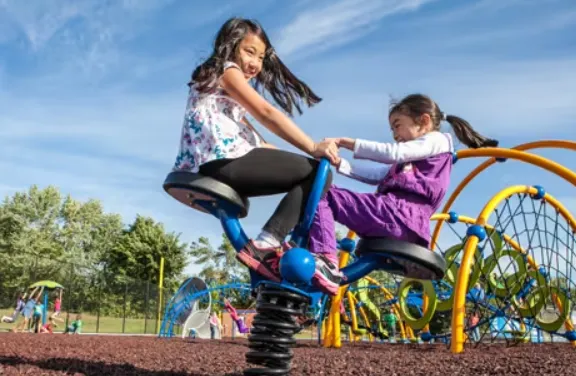
How Spring Rockers Support Active Play and Early Childhood Development
Early childhood play is not decoration around learning. It is learning. The structures children interact with shape their sensory processing, motor development, and social behaviour far more than most adults realise. Among playground equipment, spring rockers occupy a unique position. They look simple. They’re not. The rocking motion they produce engages vestibular systems, develops core stability, and builds early coordination skills that carry forward into physical and academic performance. Studies from the National Institute for Play estimate that children who engage regularly in active sensory play score up to 15% higher on early literacy and numeracy assessments. Spring rockers are one of the most effective tools for delivering that kind of play in a safe, accessible package.
What Does the Rocking Motion Actually Do for a Child’s Body?
Every time a child rocks on a spring rocker, their vestibular system gets a workout. The vestibular system lives in the inner ear and controls balance, spatial orientation, and the body’s sense of movement. It’s one of the earliest sensory systems to develop, and it needs regular stimulation to mature properly.
Rocking activates the cerebellum, the brain region responsible for coordinating voluntary movement. Regular engagement with rocking and swinging motions during early childhood has been linked to improved handwriting, better bilateral coordination, and stronger gross motor skills. Occupational therapists routinely use rocking-based sensory activities as part of sensory integration therapy for children with developmental delays. Spring rockers make this accessible on a playground, at no clinical cost.
Are Spring Rockers Suitable for Toddlers and Preschool-Aged Children?
Spring rockers are specifically designed for the 2 to 7 age range, though certain models accommodate children up to 12. The critical design feature for toddlers is the handle. Every well-designed spring rocker includes a firmly mounted handlebar that children grip throughout the rocking motion. This gives them control over their own experience and builds hand strength simultaneously.
For children under three, supervision is essential. Their core stability and grip strength are still developing. Falls from spring rockers, while uncommon on appropriate surfaces, can occur when children release their grip unexpectedly. But this should not be read as a reason to avoid the equipment. Managed exposure to minor challenge is developmentally appropriate and valuable.
How Do Spring Rockers Support Social Development?
Solo play is only part of the story. Many spring rocker designs accommodate two children simultaneously, facing each other. This setup creates immediate social interaction. Children must communicate, take turns, or synchronize their movements. These are foundational social skills that translate directly into classroom and group dynamics.
Research from the University of Queensland found that paired play equipment like dual spring rockers increased cooperative play behavior by 38% compared to single-user equipment in the same playground environment. Kids who play together on a shared piece of equipment learn negotiation, turn-taking, and empathy through direct physical experience. No lesson plan required.
What Safety Standards Govern Spring Rocker Installation?
Australian Standard AS 4685 applies to all spring rockers installed in public playgrounds. The key considerations are impact absorption, the load capacity of the spring mechanism, and the design of handlebars. Bars must be designed to prevent entrapment of clothing or limbs, and the spring’s movement range must be limited to prevent excessive tipping angles that could throw a child.
Ground surface requirements are the same as for other playground equipment. The fall zone around a spring rocker must be surfaced with impact-absorbing material such as rubber mulch, wet-pour rubber, or engineered wood chip. Compacted soil and concrete beneath these structures do not meet the Australian standard and create real injury risk during falls.
Does the Design and Theme of Spring Rockers Affect Engagement?
Significantly. A spring rocker designed as a generic seat with handles gets used. A spring rocker shaped like a horse, motorbike, dragon, or rocket ship gets used constantly. The narrative element of themed playground equipment invites imaginative play, which extends session length and deepens engagement.
Play researchers at Griffith University found that thematic playground equipment increased play duration by an average of 24 minutes per session compared to functionally equivalent non-themed equipment. Children don’t just rock. They ride their imaginary horse to another world. That cognitive layer adds significant developmental value on top of the physical benefits.
How Should Schools and Councils Select the Right Spring Rocker?
Selection depends on the target age group, expected usage intensity, and the broader playground design. High-traffic public parks need commercial-grade spring mechanisms built for heavy daily use. School playgrounds need designs that are durable, easy to inspect, and compliant with AS 4685.
Weight capacity matters more than people realise. Some spring rockers are rated to 50kg. Others go up to 100kg. Exceeding the rated capacity damages the spring mechanism over time and creates safety risks. Specifying the right capacity for the expected user group at the point of purchase prevents premature equipment failure and avoids liability complications down the track.