
Collaborative Translation: How Teams Work Together in Real-Time
For decades, translation was a relay race. A developer would export strings to a spreadsheet, email it to a project manager, who would forward it to a translation agency, who would assign it to a freelancer, who would return the file days or weeks later. The manager would consolidate the result, send it back to the developer, and pray that no string had been edited at the source in the meantime. The process was slow, fragile, and full of the kind of silent errors that surface only after release: missing variables, broken HTML tags, mistranslated UI labels that no longer fit their buttons. Every version conflict, every late edit, and every overwritten file represented hours of rework — and sometimes a delayed launch.
That model is dying. Modern collaborative translation depends on cloud-based computer assisted translation that let developers push source strings, managers track progress, and translators work simultaneously without overwriting each other’s changes. Crowdin’s team has put together a detailed overview of how CAT tools work and why they sit at the centre of every modern localization stack, which is a useful primer for anyone new to the category.
The first generation of translation tools lived on individual desktops. A translator opened a project file in a local CAT application, did the work offline, and exported the result back to whoever sent it. The translation memory and glossary lived on that translator’s hard drive, which meant every freelancer accumulated private linguistic assets that no one else could benefit from. Two translators working on the same product could each invent their own wording for the same in-game item, the same button label, the same legal disclaimer — and the project manager would discover the inconsistency only at QA, if at all.
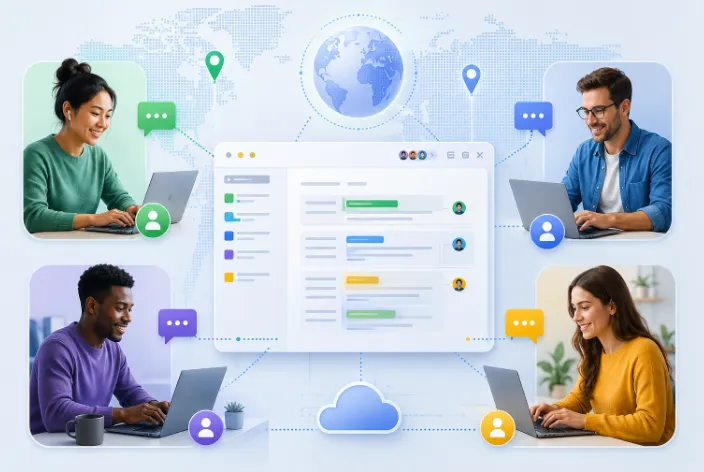
Cloud-based translation rewrote those assumptions. A collaborative translation environment is a single online workspace where the source content, the translation memory, the glossary, the screenshots, the comments, and the version history all live in one place. Anyone with the right permissions sees the current state of the project the moment they open their browser. There are no files to email, no merge conflicts to resolve, no version numbers to track. The platform itself is the source of truth.
This shift has consequences beyond convenience. When the workspace is shared, knowledge accumulates centrally. Every translation that goes through the system feeds the translation memory, which then suggests matches to every future translator working on related content. Every term added to the glossary becomes instantly visible to everyone, which means the same character name, the same product feature, the same error message is translated consistently across the entire project. The platform turns scattered individual effort into compounding team knowledge.
CAT Tools as the Operating Layer
At the technical core of every collaborative platform sit computer assisted translation tools — software that segments source content into translatable units, stores past translations in a translation memory, surfaces glossary entries inline, runs automated quality checks, and tracks who changed what and when. These tools are the operating layer on which modern localization teams run. Without them, real-time collaboration is impossible; with them, it becomes almost effortless.
A modern CAT environment offers several features that older workflows simply could not provide. Segment-level locking means that while one translator is editing a sentence, no one else can overwrite it. Inline comments let translators ask questions about a specific string without leaving the interface, and developers can answer those questions in context rather than digging through email threads. Real-time presence indicators show who is currently working in which language and on which file, which prevents duplicated effort and helps managers spot bottlenecks.
The smartest CAT tools also embed quality assurance directly into the translation flow. They flag missing placeholders, broken tags, terminology violations, and length-limit overruns the moment they happen, rather than at a post-translation QA pass. A translator who tries to commit a string longer than the UI button can hold sees a warning before saving. A glossary term that has been translated inconsistently lights up across the project. The platform behaves less like a passive file editor and more like an active collaborator that catches mistakes before they propagate.
What Developers Gain
For developers, the most valuable feature of a synchronized environment is the elimination of manual handoffs. Source strings can be pushed automatically from a Git repository, a CI/CD pipeline, or a build system, which means that any text added during development is available for translation within minutes. When translations are complete, they flow back into the codebase the same way, often through pull requests that the development team reviews like any other code change.
This continuous loop fits naturally into modern release cadences. A live-service game with biweekly patches, a SaaS product shipping daily, a mobile app updating every sprint — none of these can afford the latency of traditional translation. With CAT tools wired into a localization platform, the developer’s commit and the translator’s edit become parallel activities rather than sequential ones. Real-time localization, once the privilege of the largest publishers with dedicated localization engineers, is now within reach of two-person indie teams.
Developers also benefit from context. Modern platforms let them attach screenshots, descriptions, or even live previews to each string, which dramatically reduces the questions translators ask later. A button labeled “Save” might be translated as “save a document” or “rescue someone” depending on context; a screenshot showing the button in its actual UI position resolves the ambiguity before it becomes a bug.
What Managers Gain
Project managers used to spend more time chasing files than coordinating people. A synchronized environment changes that calculus. The platform dashboard shows, at a glance, how many words remain in each language, who has been assigned to what, how much progress was made this week, where bottlenecks are forming, and which segments are blocked on developer questions. Managers can intervene before problems escalate, rather than discovering them at delivery time.
Reporting also becomes effortless. Word counts, cost estimates, throughput metrics, fuzzy match leverage from the translation memory, and quality scores all flow out of the platform automatically. Instead of building status reports manually, managers point stakeholders at a live dashboard. The conversation shifts from “where are we” to “what should we do next”.
Terminology management is another area where managers see immediate value. A glossary maintained inside the platform is enforced automatically by the CAT tool: if a translator strays from the approved term, the system flags it. Brand voice, product naming, character names in games, regulatory terminology in finance — all of these stay consistent without the manager having to police every line.
What Translators Gain
The translator’s experience changes most dramatically of all. In the old model, a translator received a file, worked in isolation, and submitted a deliverable that might or might not be reviewed before publication. In a collaborative translation environment, the translator works inside a rich context: source string on the left, target on the right, translation memory suggestions in a side panel, glossary hits highlighted inline, screenshots above, comments from the developer below, and quality checks running in real time.
This context makes the work faster and more accurate. Translation memory matches accelerate routine segments, freeing the translator’s attention for the creative or ambiguous ones. Terminology management ensures consistency without requiring the translator to memorize a hundred-page style guide. Real-time previews — available in some platforms — let the translator see how a string will look in the actual product, which catches problems that a flat text editor would never reveal.
Crucially, translators stop being the lonely last link in a chain. They can ask questions of developers, flag source-text bugs, propose better English wording, and participate in product decisions in a way the old workflow never allowed. The best collaborative platforms treat translators as expert contributors rather than interchangeable file processors, and the quality of the resulting localization reflects that respect.
Translation Memory and Glossary: The Compounding Assets
Two assets sit underneath every successful collaborative translation effort: the translation memory (TM) and the glossary. The TM stores every translation the team has ever produced, indexed so that future similar sentences pull up past translations as suggestions. Over months and years, the TM becomes the team’s most valuable linguistic asset — a private corpus that reflects the product’s voice, its conventions, and its accumulated decisions.
The glossary is its smaller, sharper sibling. Where the TM captures sentences, the glossary captures terms: product names, feature labels, recurring phrases, words that must be translated a specific way or never translated at all. Together with the TM, it forms the backbone of terminology management, ensuring that a brand sounds like itself across every language and every release.
Both assets only compound when the team works in a shared environment. A TM built from one translator’s local files is useful to that translator alone; a TM built inside a cloud-based platform benefits every linguist who ever touches the project. The same is true of the glossary. Centralization is what turns these tools from convenience features into long-term competitive advantages.
Real-Time Localization in Practice
Real-time localization is not a marketing slogan; it is a concrete operational mode that companies running modern collaborative environments achieve every day. A developer commits a new dialogue line at 9 a.m. The localization platform detects it, slices it into a translatable segment, and notifies the assigned translators across five languages. By 11 a.m., three of them have submitted translations; by 1 p.m., the remaining two have followed. By 3 p.m., a reviewer has approved the strings, and the platform pushes them back to the repository. By the time the developer prepares the next build, the new content exists in every supported language.
This cadence used to require a dedicated localization team, expensive integration work, and a tolerance for failure. With today’s CAT tools built into mature localization platforms, it has become the default for any team willing to adopt the workflow. The technology is no longer the constraint; the constraint is organizational habit.
Common Challenges and How Teams Solve Them
Adopting a collaborative environment is not free of friction. Translators trained on older desktop tools sometimes resist cloud platforms at first, fearing slower performance or loss of offline access. Developers worry about giving outside contributors access to their codebases. Managers struggle to design permission structures that balance openness with security. These concerns are real but solvable: modern platforms offer offline modes, granular role permissions, audit logs, and integrations that keep source code separated from translatable content.
A second challenge is the discipline required to maintain the translation memory and glossary properly. A neglected TM fills with errors and inconsistencies; a stale glossary stops being useful. Teams that succeed treat these assets as living systems, with regular cleanup passes, ownership assigned to specific people, and review processes built into the workflow.
Conclusions
Collaborative translation has matured from a niche concept into the industry standard. The synchronized environment — a single cloud-based workspace where developers, managers, and translators work in parallel rather than in sequence — is no longer an experimental setup but the default for any team serious about shipping multilingual products at modern velocity. The technical foundation is provided by CAT tools that integrate translation memory, terminology management, real-time editing, and automated quality assurance into a coherent platform.
The benefits reach every role. Developers eliminate manual handoffs and ship localized content as fast as they ship code. Managers gain live visibility and consistent terminology without policing every change. Translators step into a context-rich environment that makes their work faster, more accurate, and more meaningful. The product, in turn, reaches its global audience in versions that feel deliberate rather than improvised.
The real lesson of the past decade of localization tooling is that collaboration is not just a feature to add on top of a translation process — it is the process. Teams that treat their localization platform as a strategic system, not just a vendor procurement decision, build assets that compound over time: a translation memory richer with every release, a glossary that locks in brand voice across every market, a workflow that scales from two languages to twenty without breaking. In a world where players, users, and customers expect their native language as a baseline, the teams who work together in real time are the ones who will keep up.